
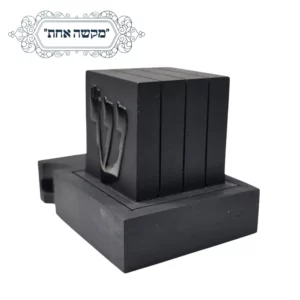
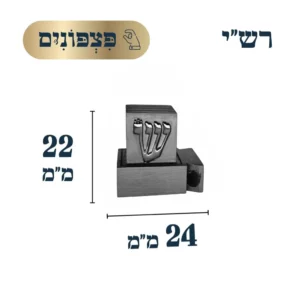
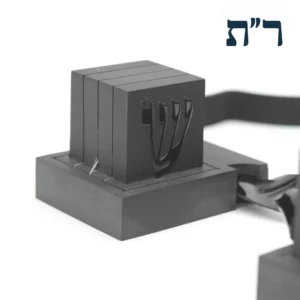
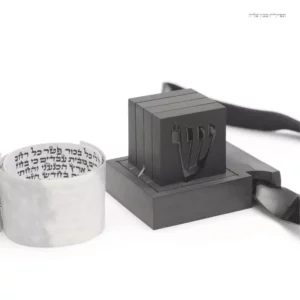
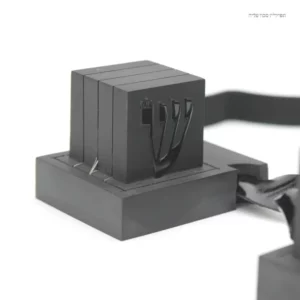
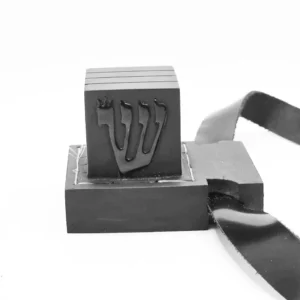

Sephardic Tefillin
Sephardic Tefillin are crafted according to the halachic rulings and traditions of Jews of Middle Eastern and North African origin, including communities from Morocco, Iraq, Tunisia, Yemen, Syria, Persia, Libya, Kurdistan, Djerba, Egypt, and more.
What Makes Sephardic Tefillin Unique?
While the basic structure of Tefillin — including the boxes (batim), parchment, and ink — is similar across traditions, the primary differences lie in the writing script of the Parshiyot (scrolls) and in certain halachic approaches unique to Sephardic tradition.
The Script
Sephardic Tefillin are written in a distinct Sephardic script, also known as “Velish” or “Mor U’Ketziah,” named after the work of Rabbi Yaakov Emden (the Yaavetz), who detailed the specific halachic forms of the letters. This script is elegant, rounded, and precise, and differs significantly from the angular style used in Ashkenazic writing.
Even Yemenite communities, which follow a traditional Yemenite script, are often considered part of the broader Sephardic tradition, as most of their letter forms closely resemble those used in Edot HaMizrach.
The Rambam and Rosh Methods
Another key difference lies in how the Parshiyot are arranged within the Tefillin. There are two main halachic traditions:
- Rambam’s Method: The first three sections (Kadesh Li, Vehaya Ki Yeviacha, Shema) are written in an “open” format, while the fourth (Vehaya Im Shamoa) is written in a “closed” format.
- Rosh’s Method: All four sections are written in the “open” format.
Since the definition of “open” and “closed” formats is itself subject to halachic debate, a special writing method was developed that satisfies both opinions simultaneously. According to the Rambam, it qualifies as “closed,” while according to the Rosh, it is “open.” This approach allows for the production of Sephardic Tefillin Mehudarot — Tefillin that meet the highest standards of halachic excellence.
Additional Differences in Wrapping Customs
Ashkenazim typically wrap the Tefillin strap around the arm from the outside inwards — meaning each turn is drawn toward the inner arm. Sephardic Jews, however, commonly wrap outwards, with the strap circling away from the body.
The number of arm wraps may also vary: seven wraps is standard among Ashkenazim, while some Sephardic communities use six.
Note: These variations in wrapping do not affect the validity of the mitzvah. Each person should follow the custom passed down through their family.
The Sephardic Tefillin Knot
The knot of the Tefillin — both on the head and the arm — is a central part of the mitzvah and carries deep spiritual significance. According to halacha, the Tefillin must be tied in a way that reflects the divine name Shin–Daled–Yud: the Shin appears on the box of the head Tefillin, the Daled is represented by the head knot, and the Yud by the arm knot. This structure is common to all traditions and imbues the Tefillin with symbolic depth.
In Sephardic tradition, the head knot is shaped like the letter Daled, as ruled in the Shulchan Aruch.
There is also special care in forming the Yud-shaped loop on the arm Tefillin — part of completing the divine name upon the body during the mitzvah.
All Tefillin offered on our site are prepared with halachically certified Sephardic knots, ready to wear out of the box — no adjustments needed.